Wednesday, January 1, 2014

Happy New Year!

I decided that New Year's Day was the perfect time to feature the first card of the 1973 Topps set. That was back in 2011, and today is the first day since the that I've had January 1 fall on a regular day when this blog runs an entry. So here it is:

Card #1 -- All-Time Home Run Leaders

This card was also the first of the All-Time Leaders subset, which appears later in the set.

None of the players shown here need much of an introduction. All are Hall of Fame Sluggers and at the time were the only players ever to hit 600 career home runs. Two of the players were still active and within grasping reach of the record. Willie Mays hit six homers and retired after the season, but Hank Aaron smacked 40 to finish with 713 round-trippers.

This was the first of four straight years where Aaron was featured on Topps' #1 card. He had also appeared as a league leader on the #1 card in 1963, so the run of #1 cards put him ahead of Ted Williams for the honor of the most appearances on a first card in the Topps set.

2014 will be the final year of this blog (assuming nothing bad happens to me which forces me to take an extended break). I still have quite a ways to go with the set, however, so so keep coming back to see what I've got planned. Oh, and by the way...once the cards run out, I'll have some more stuff to show. I'll also have a surprise ready as a way of saying "Thanks" for your readership. You'll have to see what that is, but I promise you'll like it.

Friday, September 28, 2012

A Statistican

Not a lot of people can say they struck out Willie Mays on their 18th birthday. But this guy could:

Card #375 -- Larry Dierker, Houston Astros

In 1964, Larry Dierker made his debut the same day he turned 18. Taking the mound for what were then called the Houston Colt .45s, he struck out Willie Mays in the first inning. Staying with the team through their name change to the Astros, he remined in Houston through 1976. He was the Astros' fist 20-game winner in 1969 and tossed a no-hitter against the Expos in '76. He pitched one last season in St. Louis before retiring as a player.

Known to many as a smart baseball "numbers" guy, Dierker was a member of SABR and was known to crunch the numbers of the game. He worked as a broadcaster and was also a very successful manager, taking the Astros to the postseason four of the five years he led the club. In 1999, however, he suffered a Grand Mal seizure and missed 27 games while he was unergoing brain surgery to correct the problem.

Fired after the 2001 season, Dierker returned to brodcasting and has written several baseball-related columns and two books about the game.

Wednesday, September 26, 2012

A Six-Time Draftee

This guy was drafted five times during his USC collegiate career, and ended up signing with a different team:

Card #387 -- Jim Barr, San Francisco Giants

Jim Barr was a teammate of both Dave Kingman and Bill Lee when he was with Southern California, where he was part of the team that won the 1968 College World Series. He finally signed with San Francisco in 1970 and was playing with them in 1971. By 1972, he was a regular in the starting rotation.

During that 1972 season, he showed that he was a force on the mound by retiring 41 batters in a row (over two starts, but neither was a no hitter). From 1973 through '77, Barr won at least ten games for the Giants. After the '78 season, he signed with the Angels as a free agent and pitched with them until injuries cut short his 1980 season. He was signed to the White Sox for '81, but was unable to get out of the minors. For 1982, he returned to San Francisco and pitched with the Giants through the 1983 season.

After his playing days were over, Barr spent 16 years as the pitching coach at Sacramento State.

Monday, September 24, 2012

"Foul" Ball?

I've seemed to neglect a lot of Hall of Famers on this blog lately. It's been six months since the last one was featured. Rest assured, there are plenty of them and I still have some big names left in the set including two rookie cards of Hall of Famers. But, let's toss out one of the more unflattering shots of the entire 1973 Topps set:

Card #380 -- Johnny Bench, Cincinnati Reds

From another angle, this might have been an excellent picture. Johnny Bench is making a catch of a foul ball. But...(maye that's not the word to use here) Bench's shot is taken from the worst possible angle, showing him from the back. It's been said that he sometimes refuses to sign this card because the photo is so ridiculous. Now, whether that's truth or simply a hobby legend depends on somebody taking this card to Bench at a card signing. And I'm not paying for him to scribble on this card.

I probably don't have to recap Bench's career, as he was one of the biggest stars of his day. He played his entire 17-year career in Cincinnati and led the Reds to back-to-back titles in 1975 and '76. He was a perennial All-Star, getting picked from 1968-'80 and again in 1983, and won every Gold Glove Award from 1968-'77. He was the National League's Most Valuable Player twice, in 1970 and '72. After his career was over, his number 5 was retired by the Reds.

As a rookie, he immediately showed who was the boss. Pitcher Jim Maloney kept shaking him off when he was signaling for a breaking ball because he wanted to throw a fastball. When Bench yelled, "your fastball's lost its pop!", Maloney let out a stream of expletives at the rookie. To prove his point, Bench took off his glove and caught the fastball barehanded. Maloney eventually trusted him enough to throw a no-hitter under his tutelage in 1969.

In my own youth, he was the leader of The Baseball Bunch, where he instructed the kids on the team about baseball fundamentals (along with dozens of his fellow players) and kept the San Diego Chicken in line. 

Friday, September 21, 2012

If It's Tuesday, I Must Be in Oakland...

Since the last two players featured this week were in airbrushed threads, let's just close the week out with one more:

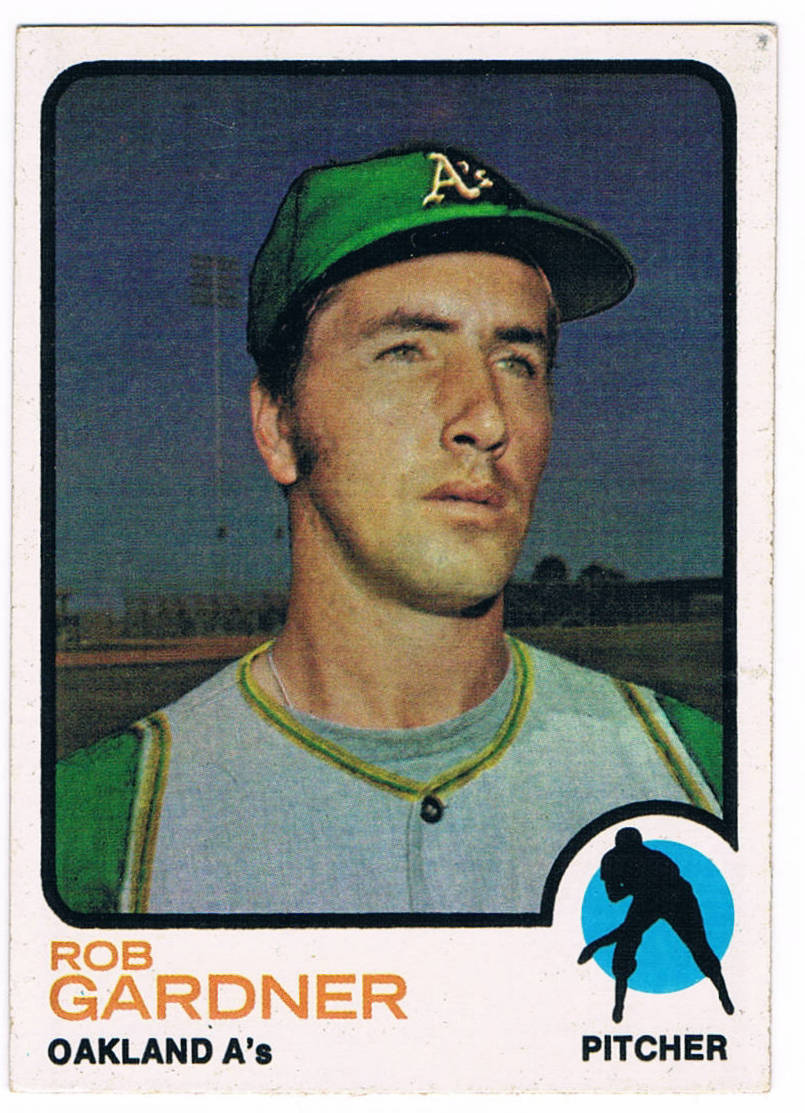
Card #222 -- Rob Gardner, Oakland A's

Ironically, Rob Gardner didn't stay with the A's very long. His contract was purchased in May by the Brewers. It was another in a long line of transactions for the southpaw -- he played with six teams in eight seasons -- and Milwaukee ended up sending him back to the A's that July. He never played in the majors again after that, though.

 Rob Garner came up with the Mets in 1965. From there, his itinerary gets a little bit fuzzy. After the Mets, he was with the Indians, the Cubs, the Yankees, the A's, the Yankees again, the A's again and the Brewers. Add to those tours of duty the trips down to the minors and you have one well-traveled player. He stuck it out in the minors through 1975 before he retired.

One thing that pops up in the long list of transactions is the fact that he was traded twice for different Alou brothers. The two times he was dealt to the A's, he was traded for Felipe and Matty Alou.

Wednesday, September 19, 2012

Un Hombre Se Llama "Huevo"

For the second entry in a row, Topps had some work to offer its airbrush artist:

Card #381 -- Vicente Romo, San Diego Padres

Vicente Romo was just beginning with the Padres in 1973, after a trade brought him from the White Sox. He came up to the majors in 1968, where he pitched a single inning before being returned to the Cleveland Indians, the team that had originally signed him in 1964. He also pitched for the Red Sox from 1969-'70. A reliever, he stayed in San Diego through 1974 and then went back to Mexico, his native country.

In Mexico, Romo was an unparalleled star. During his U.S. career, he would sometimes go home and pitch, before giving another try in the North. During the 1960s and 70s, he was one of the most feared pitchers in the LMP. He pitched a perfect game in 1967 and amassed a record 182 wins and the all-time lowest ERA in the league. His nickname "Huevo" (meaning "egg") came from the zeros that were racked up on the scoreboard when he pitched.

He did make it back to the majors, pitching for the Dodgers again in 1982. He then returned again to Mexico, where he played into his 40s. He was inducted into that country's Hall of Fame equivalent in 1992 and is still considered one of the legends of the sport there.

Monday, September 17, 2012

A Man Called "Fly Rod"

This guy's cap is an obvious airbrush job:

Card #74 -- Billy Champion, Milwaukee Brewers

Until 1972, Billy Champion had spen his entire career with the Philadelphia Phillies, with whom he debuted in 1969. The Phillies weren't a great team at the time, and Champion's overall record with the team was 12-31 during the four seasons he spent with the team. When he was traded to the Brewers, it may have seemed like a lateral move, but he was able to have a couple of quality seasons there. In four years there, he actually had a winning record with the team.

Champion was largely employed as a "swing man," alternating from the starting rotation to a mop-up role in relief. Not a really efficient strikeout artist, he managed one really good season in 1974, going 11-4 on a staff that was fairly mediocre.

Champion became a scout for the Cubs after his retirement, and a pitching coach after that.

Friday, September 14, 2012

That's Pronounced "KWAY-ar"

This player has a pretty cool 'fro peeking out underneath his Orioles cap. While it isn't Oscar Gamble-worthy, it's still cool:

Card #470 -- Mike Cuellar, Baltimore Orioles

Between 1969 and 1973, Mike Cuellar was part of one of the most feared starting rotations in the major leagues. He shared the 1969 American League Cy Young Award, made the postseason  five of those six seasons and was part of the only staff besides the 1920 Chicago White Sox with four 20-game winners. Today, it's something special when one pitcher gets 20 wins; having four on the same team is a phenomenal feat. In fact, it's been 10 years since the last time a pair of teammates (Derek Lowe and Pedro Martinez of the Red Sox) turned the trick.

Cuellar first came up with the Reds in 1959, pitching four innings and notching a 15.75 ERA. After several transactions and some time in the Mexican League, he returned with the 1964 St. Louis Cardinals, where the Cuban native took a relief role and helped the team get to the World Series. He went to the Astros the next year, where he transitioned to the rotation. After several years as Houston's prime lefty, he joined the O's in 1969.

Cuella was a four-time 20 game winner with the Orioles and logged a 143-88 record in his time with the team. But, as his advancing age dropped him to a 4-13 mark in 1976, the team released him. In 1977 he signed with the Angels as a free agent, but only pitched in a couple of games with them. He wasn't finished though; Cuellar returned to the Mexican League and continued to pitch, even making the Senior League when he was over 50.

Sadly, stomach cancer claimed him in 2010.

Wednesday, September 12, 2012

The "Redbirds"

This team has won more World Series Championships than any other team outside of the Yankees:

Card #219 -- St. Louis Cardinals Team Card

It's also the team that has retired the most jersey numbers of any team outside of The Bronx. Counting a microphone for Jack Buck, a logo for Rogers Hornsby (who played most of his career before the numbers were added) and a made-up number honoring owner Gussie Busch's 85th birthday, there have been 14 numbers retired by the team.

However, the team's dominance would be muted during the 1970s, as the team failed to win a pennant depite having a Cy Young Winner (Bob Gisbon, 1970) and a pair of MVP winners (Joe Torre, 1971 and Keith Hernandez, 1979). Despite having several Hall of Famers in the field and another in the dugout (Red Schoendienst) the team that made three World Series in the 1960s were unable to finish any higher than second place for a dozen years after the realignment into divisions.

The picture above features the 1972 team that finished in fourth place in the N.L. East, finishing 76-81 in a strike-shortened season. In 1973, they fared a little better, going 81-81 but finishing in second place in a contentious division. That said, the fans stuck by the team until "Whitey Ball" brought them more success in the next decade.

Monday, September 10, 2012

My Kinda Guy

After retiring from the game, this guy worked as a freelance writer:

Card #143 -- John Curtis, Boston Red Sox

That said, John Curtis actually had a fairly long pitching career, spanning 15 seasons from 1970-'84. He finished with the Red Sox -- the first team he pitched for -- in 1973. After the season, he was traded to St. Louis and was there through 1976. He was dealt to the Giants then, and pitched with that team until 1979. Free agency sent him to San Diego for a few years, and a purchase by the Angels in 1982 sent him to his last big league team.

His stints in Boston. St. Louis and later San Diego saw him used in the rotation, while the other teams were content to use Curtis as a set-up man. He notched 10 or more wins 5 times in his career; unfortunately, he lost more in a season (14) than he ever won (13).

After retiring, Curtis wrote pieces for Sports Illustrated as well as for several newspapers. The upstate New York-raised, Clemson educated Curtis eventually returned to the diamond as a pitching coach, beginning in 2000.  

Friday, September 7, 2012

This Guy Could Have Been in a Stroh's Commercial...Or Maybe Not

Shortly after the time this card appeared in packs, this guy was placed on waivers by the only team he'd ever played for:

Card #457 -- John Strohmayer, Montreal Expos

With the Montreal Expos, John Strohmayer had accumulated an 11-9 record since 1970. He was largely a reliever, but occasionally called to start as well, especially in 1971. With the New York Mets, he went 0-0. With only a single inning at the end of 1974 after a season in the minors, his career was finished.

A South Dakota native, Strohmayer was bothered late in his career by shoulder problems. So he went to school and became a teacher. He taught in California from 1976-'92 and worked his way up the rakns from there, eventually becoming a superintendent by 2002. He retired from that career in 2009 after 32 years.

That year, he took a share of a lottery jackpot worth millions.

Wednesday, September 5, 2012

The Switch at the Keystone

At the time this card was issued, this player was a regular shortstop. The next year, he switched to second base:

Card #144 -- Marty Perez, Atlanta Braves

Here's a little-known fact about Martz Perez: he is one of the few players who ever pinch hit for Hank Aaron. Even late in his career, few could say they ever picked up a bat and stood in for "The Hammer."

Perez came up in 1969 with the Angels after growing up in Visalia, California. After the 1970 season, he would be traded to the Braves, the team that used him most on the diamond. He stayed with them through 1975, when he was sent to the Giants in a deal that also included Darrell Evans. After that, he seemed to move around frequently: in '77 he was dealt to the Yankees but only used in a single game. A month later, the Yanks sent him to Oakland. He became a free agent at the end on the season, but resigned with the A's. However, the team released him in 1978 and he signed with the Mets. Once that team -- as bad as it was -- kept him in the minors, he saw the writing on the wall and retired.

Monday, September 3, 2012

Jason's Dad

1973 was this guy's first full year as an everyday major league catcher:

Card #221 -- Fred Kendall, San Diego Padres

Unfortunately, he played with the Padres, who lost over 100 games that year. That may account for the "deer in the headlights" look that Fred Kendall gives in this portrait. After first coming up with the team in 1969, he backed up Chris Cannizaro, Bob Barton and Pat Corrales. And those guys took a real licking on the early Padres teams (in fact, Corrales's card shows the result of the battering those guys often took). In the 1972 season, Kendall was the next guy on the firing line.

He remained the Padres' regular backstop through 1976, an era where the team never saw a winning season. In 1977, he was finally given a chance to play with another team; unfortunately, that team was in Cleveland and they weren't much better. The next season, he was traded again to the Red Sox. It was a team that was in contention for much of the year and reuinited him with his old skipper Don Zimmer...but had a Hall of Fame-caliber presence behind the plate in Carlton Fisk.

So, he went back to his original team as a free agent and spent the next year and a half there before retiring. After his playing days, he followed the lead of many catchers and went into managing. For four years, he was a skipper in the White Sox's system and then became Buddy Bell's preferred bullpen coach. His son was Jason Kendall, who was also a big league backstop from 1996-2010.

Friday, August 31, 2012

Jim Ray from Hookerton

This player was a decent hitter, and the picture highlights that well:

Card #538 -- Jim Hart, San Francisco Giants

But then again, with teammates like Willie Mays, Willie McCovey and Orlando Cepeda batting around you in the lineup, you're going to get your share of good pitches. While this card shows Jim Ray Hart as an outfielder, he actually came up as a third baseman in 1963 and supplanted Jim Davenport from his regular position. Since Hart's bat was better than his glove, however, Davenport eventually retained his spot in the late 1960s as age and injuries began making Hart more of a liability at the "hot corner."

At that point, Hart moved to the outfield primarily, but still backed up his old position occasionally. While he never appeared in a postseason and only got into one All-Star game, Hart was a critical part of the Giants' attack in the 1960s. As his skills diminished, Hart was sold the the Yankees during the 1973 season with the hopes that the new designated hitter position could capitalize on his hitting prowess and keep his glove off the field. He lasted in that capacity until early in the 1974 season, when he retired.

After his playing career, Hart went to work as a warehouseman for Safeway in California.

Wednesday, August 29, 2012

Red All Over...

This player's nickname came from his mane of red hair, but the picture here skews the color out of proportion:

Card #591 -- Mike Hedlund, Cleveland Indians

However, despite the airbruhing job, Mike Hedlund didn't even make it onto the Indians' roster in 1973 and never pitched a major league game after 1972. He had played for the Indians, though: he came up with the team in 1965 and again in 1968. However, he appeared in a total of six innings for them in his two stints before being claimed by the Kansas City Royals after the '68 season in the expansion draft.

The Royals used Hedlund as both a starter and reliever during their first four seasons, and was most effective when used from the bullpen. Unfortunately, he contracted the Hong Kong Flu with pitching in Venezuela after the 1969 season and suffered after that. When the 1972 season ended, he was dealt back to Cleveland; after spending all of '73 in the minors for them an '74 in the White Sox' farm system, he hung it up after he discovered he was about to be dealt to the Reds in '75.

Monday, August 27, 2012

The (Other) Hammer

This player's nickname was derived from the fact that he was a Hank Aaron fan:

Card #4 -- John Milner, New York Mets

The Atlanta native was still a teenager when the Braves moved into his hometown. Unlike many fans, he actually spent several years on the same diamond as his idol. His nickname wasn't ironic, either: he had some power, slugging ten grand slams in his career even though hit hitting might not have been up to the same standards as Aaron's.

John Milner came up with the Mets late in the 1971 season and finished third the next year in Rookie of the Year voting. At first, he was in a platoon system with Cleon Jones in left field, but transitioned to first in 1973. Despite suffering a hamstring injury early that year, he managed to return and help his team into the World Series. Milner remained with the Mets through the 1977 season before being dealt to the Pirates.

In Pittsburgh, where Willie Stargell was ensconced at first, Milner accepted more of a utility role with the club. While backing up Stargell and Bill Robinson in left, he also filled in wherever he was needed and was a key cog of the team's 1979 World Series-winning "Family." He was sent to Monreal in 1981, but returned to the Pirates in 1982 and finished his career.

In 1985, his name popped up again in the sports pages when he testified in the Pittsburgh cocaine trials. He admitted to using the drug during his time in Pittsburgh and even confirmed the oft-repeated rumour that amphetamines and "greenies" were readily available as long as he was in the majors.

Also during the 1980s, his cousin Eddie Milner suited up with the Reds and Giants. Sadly, John Milner died in 2000 of lung cancer.

Friday, August 24, 2012

Gullett

Thanks to the advent of free agency, this man was on the World Series-winning team for four consecutive years:

Card #595 -- Don Gullett, Cincinnati Reds

At the time this card was issued, Don Gullett was coming off of a disappointing 9-10 season, with an additional 0-2 mark in the postseason.1972 would be his only losing campaign, however. In nine years, he would post a final 109-50 mark, a terrific .686 winning percentage. While you might think that having players like Rose, Bench, Morgan, Perez and later Reggie, Thurman and Chambliss helping him out, he was known as a crafty pitcher who could get the job done on his own. Pete Rose said he was "the only guy who can throw a baseball through a car was and not get the ball wet."

Gullett was signed in 1969 by the Reds and came up to the team the next year while still 19 years old. As a rookie, he appeared in the 1970 World Series, earning a save against the Orioles. He would return to the Series with the Reds in 1972, 1975 and 1976, winning rings in the last two. Despite showing signs of injuries, his arm was as much a factor in the Reds' back-to-back titles as the fabled hitting of its stars, and Gullett was one of the early recipients of the free agent bonanza. He signed a six-year, two million-dollar deal with the Yankees after beating them in the 1976 Series.

Gullett's arm troubles would pop up again and limit his time in pinstripes, but not before seeing him lead the American League with a .778 winning percentage in 1977. In 1978, his arm troubles finally caught up with him, requiring surgery after eight games. He remained on the Yankee's roster through 1980, but was unable to pitch in the majors again.   He returned to the Reds after retiring, serving as their pitching coach from 1993-2005.

Wednesday, August 22, 2012

Slip Him a "Mickey"

Here's a player who was really popular with fans of the Detroit Tigers:

Card #88 -- Mickey Stanley, Detroit Tigers

"Mickey" is a great American name.While it was most associated with a guy who played outfield for the Yankees from 1951-'68, There were others, and Mickey Stanley was another outfielder. A native of Grand Rapids, Michigan, he played in the Motor City for his entire career. However, it was a short-term move to shortstop in 1968 that the Tiger faithful remember best about him.

Originally an outfielder who had been a part-timer since coming up in 1964, Stanley was moved to shortstop late in the 1968 season once the Tigers had already clinched the pennant. He replaced weak-hitting Ray Oyler, whose anemic batting average was considered one of the team's problem areas. Since the outfield was already packed with Al Kaline, Willie Horton and Jim Northrup, manager Mayo Smith hoped that Stanley's speed would make up for his lack of familiarity at the position. The move was considered to be one of the top 10 best coaching decisions of the 20th century, and the Tigers won the World Series against a formidable St. Louis Cardinals team.

Oyler was drafted by the Pilots the next year, but the experiment at short didn't last long into 1969. With his outfield range and ability to get a quick step against balls heading towards the gaps, Stanley returned to his original position and stayed out there for the remainder of his career. When the designated hitter position opened up, Kaline's assumption of that role allowed Stanley to play the most games of his career in 1973. He remained a full-timer until Ron LeFlore arrived in 1975, then returned to a part-time role as a utility player and late-inning defensive replacement. From then until 1978, Stanley took the field where he was needed, at every position except pitcher and catcher. 

Monday, August 20, 2012

What's Better Than Playing For Your Idol?

Here's another player whose career was basically over before it was issued:

Card #512 -- Dalton Jones, Texas Rangers

Finishing his career in Texas meant that Dalton Jones played for his boyhood idol Ted Williams, who managed the team at the time. And it was Williams who was used as a recruiter to entice Jones to sign with the Red Sox in 1961. He played with the BoSox from 1964-'69, and was a part of their "Impossible Dream" season of 1967. A backup for both Joe Foy at third and Mike Andrews at second that season, he played in six of the Series' games and put up a .389 average.

Before the 1970 season, Jones was traded to the Tigers. It was with Detroit that he made his most infamous hit: a three-run single that should have been a grand slam. When Jones hit the towering shot, the runners weren't certain if it would land in the seats or on the field. As a result of poor communication, Jones passed Don Wert between first and second and was called out. Jones was the goat, he blamed Wert for not running, and I say the first base coach was partially responsible. He should have seen what was going on.

Jones was traded to Texas early in the '72 season, reuniting him with Williams. The Rangers released him in the spring of '73, or just about the time his card showed up in packs. Jones signed with the Expos but failed to rise above the AAA level and retired when the year was over. As a result, the staitsics on the back of this card show his final record in the majors.

After his retirement, Jones pursued opportunities outside of baseball, working for a bank and then the Exxon company.

Friday, August 17, 2012

Part of the "Veale, Lamb and Moose" Combination

This pitcher spent his entire career in Pittsburgh, which in 1970-'71 also boasted Bob Veale and John Lamb in their arsenal:

Card #499 -- Bob Moose, Pittsburgh Pirates

Veale is perhaps the best-known of these pitchers, but Bob Moose was the only one who tossed a no-hitter in the majors. He tossed his gem against the eventual World Series champion Mets in 1969. At the time this card was issued, he had just made a big mistake, uncorking a wild pitch in the bottom of the ninth during the final game of the NLCS -- the result was the image on this card -- that allowed the Reds to advance to the World Series and was the last game Roberto Clemente ever played.

Moose signed with the Pirates in 1965 and came up to the team late in 1967. By 1968, he earned his spot in the rotation and posted double-digit win totals from 1969-'73. In 1971, he pitched in three games in the World Series en route to winning the only ring of his career. In 1974, however, a blood clot under his pitching arm required surgery (and the removal of one of his ribs). Moose was never really an effective pitcher after that, but pitched through 1976.

Sadly, on October 9, 1976 -- his 29th birthday -- Bob Moose was driving a car to Bill Mazeroski's golf course when his car veered off the road and into the path of another car. Tragically, he died in the accident.