Wednesday, February 29, 2012

Uncommon Balor

This was the first player drafted by the Montreal Expos during their first season in 1969:

Card #211 -- Balor Moore, Montreal Expos

Unfortunately, Balor Moore would be drafted by another organization -- the U.S. Army -- a couple of years later and miss the 1971 season. After a 9-9 record in 1972 and a 9-16 showing in '73, his career was affected by a number of injuries. In 1974, he injured his ankle during Spring Training and then elbow surgery ended his season. He wouldn't return to the majors until 1977 with the Angels, then a three-year stint with the Blue Jays. He spent '81 in the minors before hanging it up.

Though Moore's career didn't end up living up to the high hopes the Expos initially had for him, he did have one highlight that needs to be mentioned. After the '72 season, Moore pitched the first nine-inning no-hitter ever tossed in the Puerto Rican League. After retiring, Moore entered the steel business and owns a pipe company in his native Texas today.

Monday, February 27, 2012

Celerino

This player was only in the major leagues for parts of two seasons, but was a big enough star in the Mexican League to be inducted into their Hall of Fame:

Card #103 -- Celerino Sanchez, New York Yankees

The card above shows that Celerino Sanchez was a third baseman. While he played that position exclusively in 1972, he was largely of the good field/no-hit mode, and the Yankees' acquisition of Graig Nettles ended any chance of getting any significant time at the position. He filled in where he was needed (including DH, at shortstop and in the outfield), but was little more than a bench player in 1973. As a result, he returned to Mexico. His final game as a Yankee was also the final game for Yankee Stadium before its renovation. He replaced Nettles in the seventh and drove in a run; however, the Yankees lost the game late to the Tigers.

Sanchez had been a star in his native country during the 1960s. In 1966, he won a Triple Crown in the Mexican League, hitting .448 for the season. The Yankees saw potential in him and traded to get him in 1971. After returning, he would spend the rest of the decade in Mexico (except for 1978, when he didn't play at all) to round out his career.

Tragically, Celerino Sanchez was killed because of a car accident in 1992.

Friday, February 24, 2012

Yes, His Middle Name Was Henry

In 1972, this player was traded from the Cleveland Indians to the Texas Rangers. It was his first chance to be an everyday player:

Card #299 -- Ted Ford, Texas Rangers

Unfortunately, the Rangers ended up sending Ted Ford back to Cleveland in the Spring of 1973. It would be Ford's final season in a major league uniform, getting into 11 games. He stuck around in the minors through 1974, however, before calling it a career.

Drafted by the Indians in 1966, Ford was drafted again -- by Uncle Sam -- and missed the 1968 and '69 seasons while serving in Vietnam. Once his military hitch was up, he returned to the game and made the Indians' roster in 1970. Ford was shuttled back and forth between the Tribe and their AAA affiliate in Wichita for the next couple of seasons until his trade to Texas.

Ford played all three outfield positions, filling in wherever he was needed. In Texas, he was mianly used in right field. His grandson Darren Ford came up with the San Francisco Giants in 2010.

Wednesday, February 22, 2012

Keeping Track, Part 3

Today is one of the five days I can just show a card, be lazy and still get in a post to this blog before my self-imposed deadline passes:

Card #338 -- Checklist 3

There's really nothing to research with a checklist card. This is the third of the five checklists in the 1973 Topps set, and the third that's been featured on this blog.

That said, it looks like the original owner of this card had all the cards in this run in his collection. The back is all marked off, as well.

Monday, February 20, 2012

Where's Floyd the Barber?

While this "Mayberry" didn't have Opie, Barney or Aunt Bea, he was a "classic" in his own right:

Card #118 -- John Mayberry, Kansas City Royals

John Mayberry originally came up with the Astros, with call-ups between 1968 and 1971. The team grew concerned that he was striking out too much, so he tried to be a little less wild at the plate. Unfortunately, his power numbers dropped off  and he was traded to the Royals after the '71 season.

He immediately stepped into a starting position at first base in Kansas City, and that trade is considered one of the worst of the decade. Mayberry was one of the few heavy power hitters in the team's lineup and enjoyed career years from 1972-'75. His numbers tailed off in 1976 and a falling out with manager Whitey Herzog ended up with Mayberry getting benched for the ALCS and then blamed for the team's subsequent loss to the Yankees. He was soon traded again, to Toronto, a team that had just finished its first season.

Although his level of play was reduced from what he'd shown a few seasons before, Mayberry was a veteran presence for the Blue Jays. He remained with the team through 1982, when he was traded to the Yankees. That proved to be his final season.

His son is John Mayberry, Jr., who curently plays for the Philadelphia Phillies.

Friday, February 17, 2012

The Comeback Kid

Last time, I featured a player who enjoyed a long career and excelled during the later years. This guy did that, too:

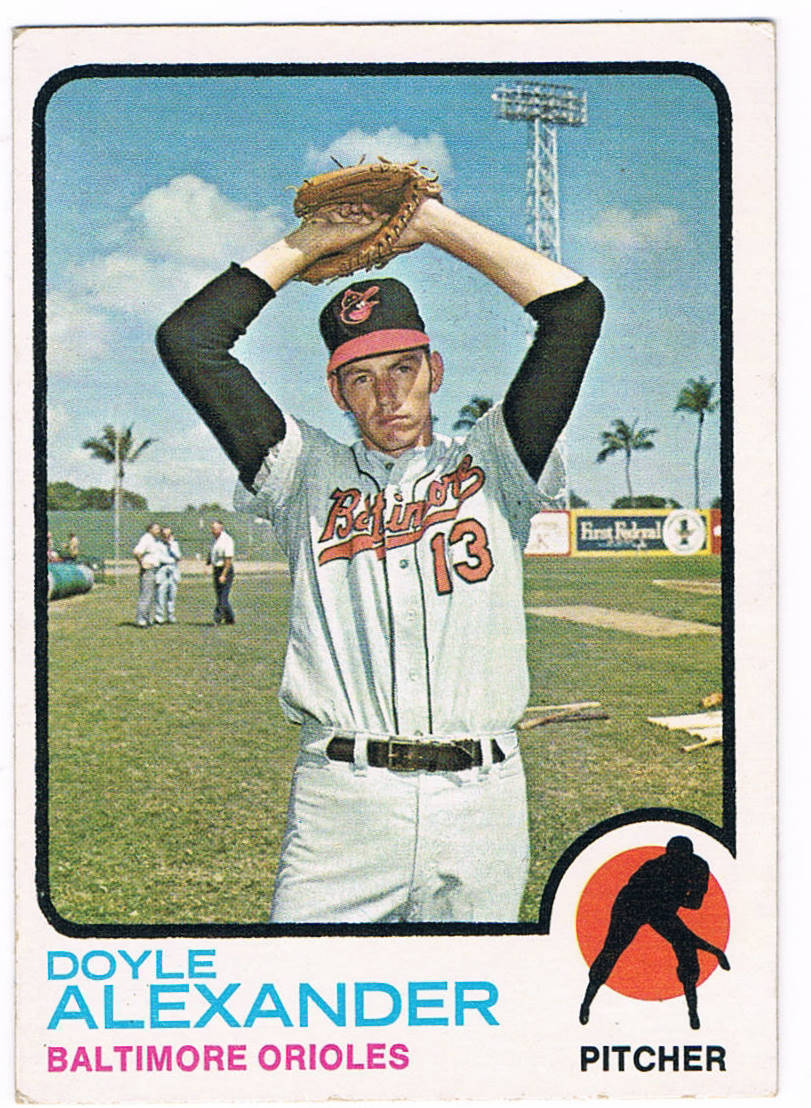
Card #109 -- Doyle Alexander, Baltimore Orioles

Doyle Alexander looks sad in this picture (despite the more tropical spring air and the palm trees around him), but 1973 would be his first winning season. However, it was the only one he would enjoy between his rookie season with the Dodgers in 1971 and his tenure with the Orioles. As a result, he was included in a massive ten-player trade between Baltimore and their A.L. East rival New York Yankees. The change paid immediate dividends, both for the Bronx Bombers, who went to the World Series for the first time in a dozen years, and Alexander, who had a 10-5 record with them as he helped to get them there. He lost game 1 of that year's World Series and signed as a free agent with Texas afterward.

Over the next several years, he pitched for the Rangers, Braves, Giants and the Yankees again. He was effective in 1977, but inconsistent after that, watching his ERA rise and his record dart around. In '83, the Yankees dropped him and he signed with the Blue Jays, a move that once again jump-started his career. He would win 17 games in both 1984 and '85 and helped the Jays win their first division title in the latter year. He went to Atlanta once again in 1986, but was traded once again the next year.

In that trade, Alexander became a Tiger, and the deal paid dividends for both teams. The Tigers' part paid off immediately, as Alexander (who at 36 was assumed to be washed up) ran up a 9-0 record and once again served as a catalyst for a division title. 1988 was another decent year, but his age finally reached up to him in '89 and he retired after the season.

Wednesday, February 15, 2012

A Man Called "Suds"

This player is airbrushed into the uniform of the team that purchased his contract midway through the 1972 season:

Card #572 -- Gary Sutherland, Houston Astros

Sharp-eyed readers might recognize the background as a similar area where many Montreal Expos players are shown, and that's the team where Gary Sutherland filled a roster during Spring Training in 1972. In fact, he moved around a lot, playing on seven different teams in 13 overall seasons.  He first came up with the Phillies in 1966 and moved to the Expos during thier inaugural season in 1969. His tenure with the Astros was over after '73.

He then went to the Detroit Tigers, where manager Ralph Houk made him the team's leadoff hitter. That might seem odd given his low batting average, but Houk seemed fond of placing second basemen into the first spot on his lineup (Bobby Richardson and then Horace Clarke with teh Yankees, and later Jerry Remy in Boston). He stayed in that position until Ron LeFlore arrived with the Tigers, and finished the 1976 season with the Brewers. He then spent partial seasons in San Diego and St. Louis before retiring after the '78 season.

After his retirement, Sutherland tried his hand at selling real estate in California. Eventually, he missed baseball and became a scout for the Padres in 1980. While there, he was the person who brought Tony Gwynn to the team. He remained a scout for several years afterwards, and works for the Angels today.