Wednesday, May 4, 2011

Cub #1

The title of this post has a double meaning. Not only was Jose Cardenal wearing uniform #1 for the Cubs, he also led the team in batting, doubles and stolen bases. Here is the man named Cubs Player of the Year for 1973:

Card #393 -- Jose Cardenal, Chicago Cubs

While he appears to be squaring for a bunt, Cardenal may simply be sneaking up on the camera. He gained a reputation for imaginative excuses. He was known to watch for bugs in the Wrigley Field ivy during long stretches of games. He once asked to sit out a game and told Whitey Lockman that crickets in his hotel room had kept him up all night. Another time he claimed his eyelid was stuck open.

Something tells me that if Jose Cardenal hadn't been a decent outfielder -- he definitely was -- some team might have kept him specifically for the comic relief.

Cardenal played for nine different teams between 1963-'80. After his playing career was finished, he became a coach. From 1996-'99, he won three World Series Rings (something he never managed as a player) as a member of the New York Yankee coaching staff.

Monday, May 2, 2011

A Small Cloud of Dust

While the cloud of dust at his feet looks a little neat, it could indicate he has just thrown his pitch into the dirt:

Card #636 -- Rick Clark, California Angels

For Rick Clark, it was a metaphor for his major league baseball career. Though this card appeared in Topps' final series in 1973, he was done with the big leagues and never played at all that year. He was purchased by the Phillies before Spring Training began and spent the entire season at the AAA level.

Clark's Wikipedia entry is exactly one sentence long. The back of this card features more information about his career than that. Although he won 12 games as a rookie in 1967, his record after five partial seasons was 19-32. That may have marginalized him a bit.

Friday, April 29, 2011

"Kison" the Cheek...

Quick...who earned the win in the first night game in World Series history? The answer:

Card #141 -- Bruce Kison, Pittsburgh Pirates

This picture shows how lanky Bruce Kison was. However, his body size allowed him to use his log arms to give a sidearm delivery that kept batters on their toes. He was also known for being wild, hitting several opponents. Later, he admitted that blisters caused much of that, but it didn't make him popular during his playing days.

On October 13, 1971, Bruce Kison took the mound against the Orioles. While taking until 1971 to get a night game might be surprising since all Series games are played at night now, it is more surprising how quickly the Series day games disappeared after that. A couple of other significant things happened in that Series: Kison tied a record by hitting three opposing batters in that night game, and got married the same day his team won the championship.

Kison stayed with the Pirates through 1979, which gave him a second Series ring. He was a key member of the rotation despite never getting more than 14 wins in any season. In 1980, he went to the Angels and helped them get to the postseason in 1982. He finished his major league career in Boston in '85. He went on to play in the Senior League in 1989 and coached for several teams before becoming a scout. He's still doing that today, for the Baltimore Orioles (the same team he beat in two World Series).

Wednesday, April 27, 2011

Another Really Busy Picture

Chris Speier scores, and a bunch of players are on hand to witness it:

Card #273 -- Chris Speier, San Francisco Giants

Among the Giants, the batter in the on-deck circle is watching the play, while third base coach (John McNamara?) looks on. The entire Phillies bullpen is in the shot, as well as Don Money at third. The catcher is either Tim McCarver or John Bateman, since both would wear uniform number 6 for the 1972 Phillies as they were traded for each other. I'm guessing it's McCarver. In the middle of the action, there's a sliding Chris Speier.

Chris Speier enjoyed a long career, playing 19 seasons from 1971-'89. He bookended his big league career with two stints in San Francisco. Most of the rest of his career was spent in Montreal. He was a solid player, even if he didn't live up to his initial potential. He would be named to the All-Star team three straight years (1972-'74) and played in three National League Championship Series. Interestingly, the Giants made the Series in 1989 but Speier sat out that postseason.

After retiring, he became a minor league roving instructor and a hitting coach. Today, he is the bench coach for the Cincinnati Reds.

Monday, April 25, 2011

The Card That Finished it Up...

Today is the one-year anniversary of this blog. At the rate I feature cards here, I should be able to keep this going for about four more years.

Marking the milestone, here's the final card I picked up (at the Chicago National in 2005) to complete the base set:

Card #590 -- Deron Johnson, Philadelphia Phillies

Johnson moved around often during his playing days, and 1973 was no exception. He was traded to Oakland a month into the season, which meant he immediatey went from a developing team to a contender. He managed to win a World Series title with the A's, something he didn't get do enjoy as a Yankee early in his career. As his career wound down, Johnson would be picked up by the Red Sox to help them in their '75 pennant drive after Jim Rice was injured, but it was too late to qualify for the postseason roster. As a result, that '73 Series ring would be the only one Johnson managed to earn.

When the A's picked up Johnson in 1973, it was one of the first times a team specifically looked for a player who could be a full-time designated hitter. Since it was the first year of the DH rule in theAmerican League, few had considered the value of going after a player whose field time was limited due to injuries and age. While it's a common thing today, Johnson was one of the first to fill that role.

After retiring in 1976, Johnson would go on to become a minor league manager and coach a number of major league teams through 1991. Sadly, he was diagnosed with lung cancer that year and died in '92.

Friday, April 22, 2011

Nice Shirt...

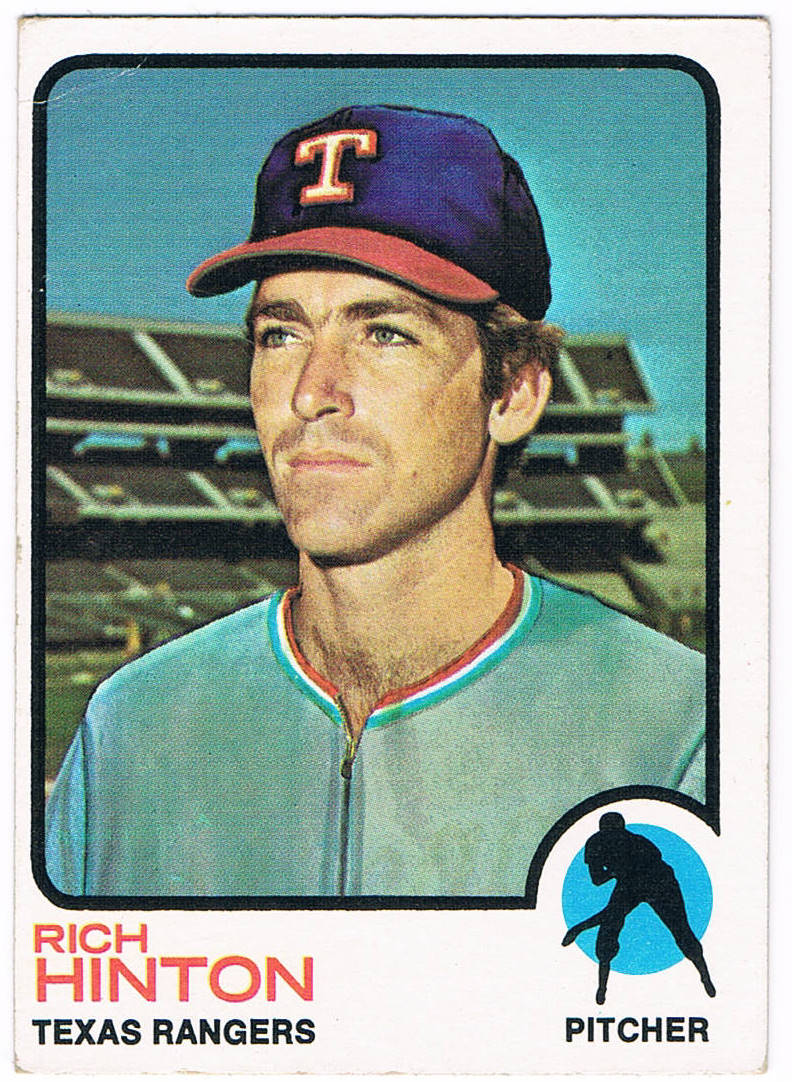
This is a really obvious case of a Topps artist painting a new uniform. The cap is actually pretty good, but the shirt gives it away:

Card #321 -- Rich Hinton, Texas Rangers

His Texas uniform is airbrushed because he was traded away from the Yankees really late in the 1972 season, but he never appeared with the Rangers in 1973. He was traded before the season to Cleveland and sent to the minors. He wouldn't return to the majors again until 1975, as a member of the Chicago White Sox. It would be the second of three stints for the Southside nine.

Hinton played parts of six seasons between 1971 and '79, and never really managed to fit in as a regular. He was normally a relief specialist -- or a set-up man as they're called today -- and managed to toss two complete games in 1978.

Wednesday, April 20, 2011

The Defending Senior Circuit Champs

No, this post has nothing to do with an over-50 league, even if a few of the players featured stuck around in the majors until they were over 40. For those who don't keep up with old newspaper sports jargon, the Senior Circuit is the National League.

While some collectors might consider this to be a worthless card, I say it's a one-of-a-kind item that belongs in my collection:

Card #641 -- Cincinnati Reds Team Card

Really, who else has an eight-cornered Reds team card? It's unique.

Taken at Riverfront Stadium, the team photo is loaded with stars. Not only are Johnny Bench, Joe Morgan and Tony Perez in the Hall of Fame, so is manager Sparky Anderson. Pete Rose is pictured as well, as is another man who was incredibly popular when he was a Reds player: Ted Kluzsewski. Davey Concepcion, George Foster and Ken Griffey are also part of what was a solid team.

Although the Reds lost the '72 World Series to the Oakland A's, they didn't let it bother them. Instead, they won back-to-back titles in '75 and '76, beating two teams that have perhaps the most vocal fans in the game.

But check out the guys on the left. I'm assuming those are the clubhouse manager and traveling secretary (please add to the comments if you know), but they remind me of Mr. Carlson and Les Nessman from WKRP in Cincinnati. Yes, that show may have come out five years after this card, but the fact that both are set in the same city doesn't escape me.